AC Contactor Troubleshooting Index: Symptom to Cause to Fix
Find the right diagnostic page in minutes: a five-minute triage flow, a twelve-symptom index table and the repair-or-replace decision line for AC contactors.
Read More
The AC contactor market is not one market. It is at least four — OEM machinery, building services, process industry and power & renewables — divided further by three standards worlds (IEC, UL, NEMA) and supplied from a handful of manufacturing clusters whose specializations differ more than their prices do. Public “market size” figures conflict by billions of dollars and get recycled across reports, so this page deliberately avoids them and maps the structure instead: who buys, under which standard, and where the supply actually comes from.
The same frame ladder is sold into three regulatory regimes, and the regime decides what “equivalent” means. A 25 A IEC frame does not substitute for a NEMA size 1, and a UL Recognized component is not a UL Listed device — the distinction matters to whoever signs off the panel.
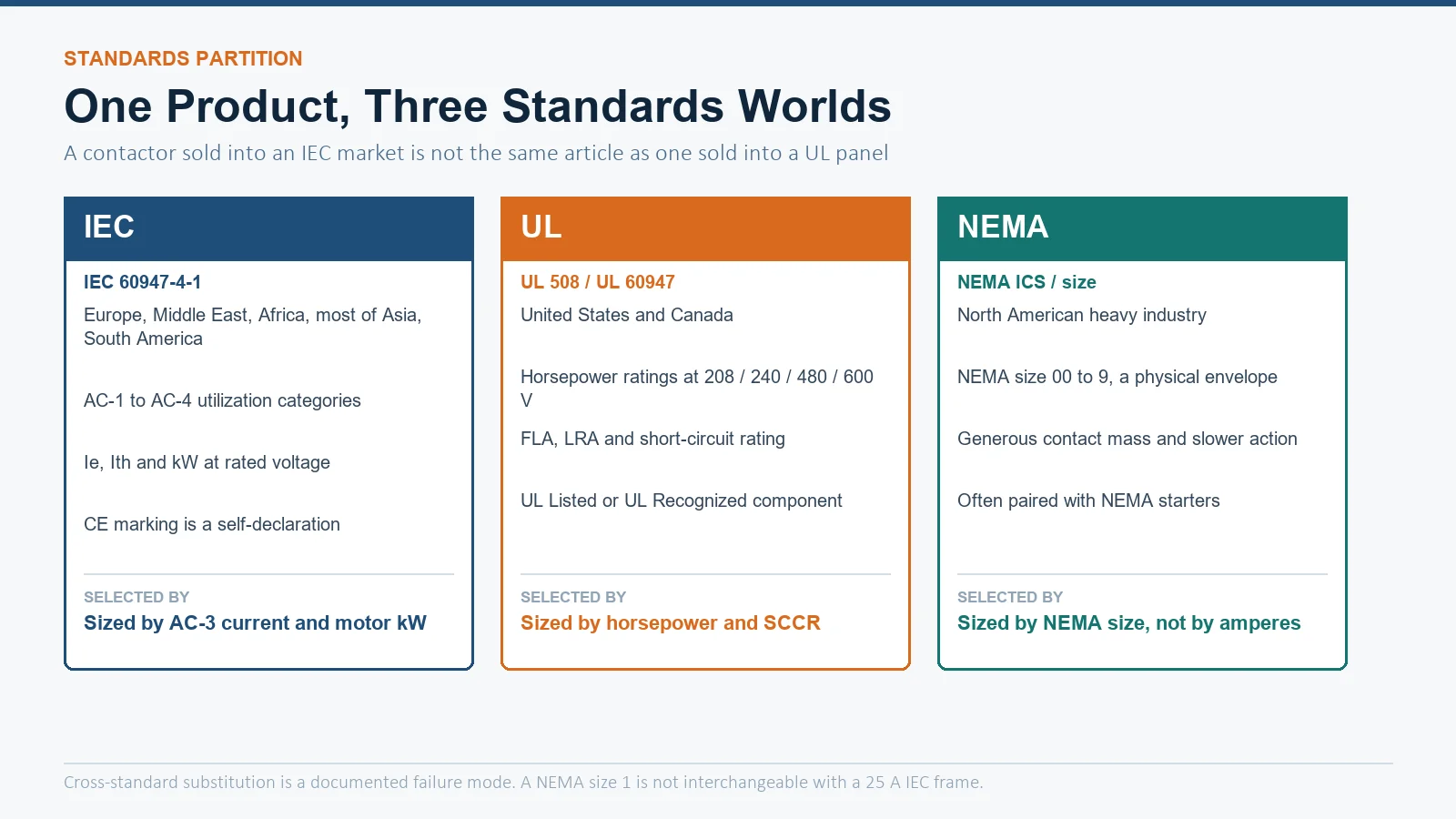
| IEC world | UL world | NEMA world | |
|---|---|---|---|
| Regions | Europe, Middle East, Africa, most of Asia, South America | United States and Canada | North American heavy industry |
| Governing standard | IEC 60947-4-1 | UL 508 / harmonized editions | NEMA ICS size classes |
| Rating language | AC-1 to AC-4 utilization categories; Ie, Ith, kW at Ue | Horsepower ratings at 208/240/480/600 V; FLA, LRA, SCCR | NEMA size 00 to 9 — a physical envelope, not a current |
| Certification | CE self-declaration backed by IEC test reports; CB scheme for export | UL Listed or UL Recognized component | Often paired with NEMA starter lines |
| Sized by | AC-3 current and motor kW | Horsepower and short-circuit rating | NEMA size, generously dimensioned contacts |
Buyers sourcing across regions should treat this as the first filter of any RFQ. The AC-3 rating chart decodes the IEC language; the definite purpose vs general purpose comparison covers the UL-side split that surprises European buyers most often.
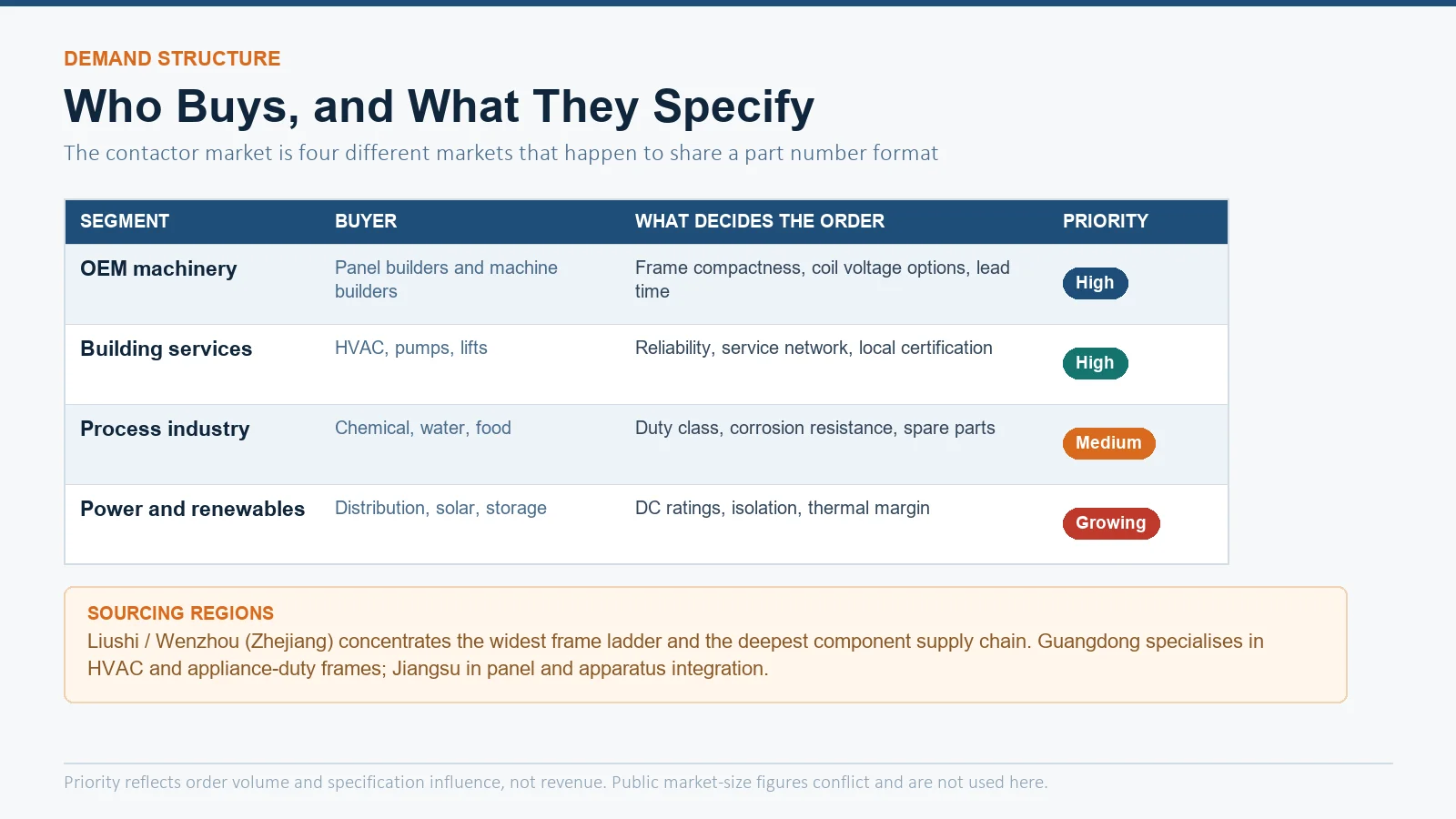
| Segment | Buyer | What decides the order | Priority |
|---|---|---|---|
| OEM machinery | Machine builders, panel builders, system integrators | Frame compactness, coil voltage range, lead time, price per point | 高い |
| Building services | HVAC contractors, pump and lift suppliers, FM companies | Reliability, service network, local certification | 高い |
| Process industry | Chemical, water, food and beverage plants | Duty class, corrosion resistance, spare-part continuity | ミディアム |
| Power & renewables | Distribution OEMs, solar and storage integrators | DC ratings, isolation requirements, thermal margin | Growing |
Two shifts are reshaping the demand base. First, renewable and storage applications pull demand toward frames with genuine DC ratings and higher isolation — a segment where the DC arc extinction requirements disqualify repurposed AC product. Second, panel miniaturization keeps pushing OEM machinery buyers toward compact and modular DIN-rail frames, where the manufacturer landscape differs from the classic contactor supply chain.
The densest low-voltage apparatus cluster in the world. Its advantage is the frame ladder itself: from 9 A distribution duty to 630 A process frames, every component — silver tips, coil wire, mouldings, mechanisms — has local suppliers within an hour’s drive. This is where the deepest cross-referencing capability sits: a factory here can usually match an LC1-D style frame or a CJX2-F series unit with short tooling lead times. The buyer’s task in this cluster is supplier discrimination, not availability — the factory vs trader vetting guide exists precisely for this market.
Strongest in HVAC and appliance-duty contactors, definite-purpose frames and high-volume assembly. Minimum order quantities tend to be larger, per-unit costs competitive, and the logistics chain to consumer-appliance OEMs mature. Best fit for high-volume standardized frames rather than mixed ladder orders.
Historically strong in panel building, power distribution apparatus and integrated assemblies. Where an order bundles contactors with starters, protection devices or engineered panels, this cluster’s integrators shorten the supply chain compared with buying components separately and assembling elsewhere.
A growing second source driven by tariff geography and supply-chain diversification. Assembly depth varies widely; many operations complete or package product from Chinese component supply. For buyers with geopolitical or tariff constraints, viable — but the component-depth advantage of the established clusters still shows in lead time and customization response.
Four practices convert the map into better orders:
Price is half the commercial picture; availability is the other half, and it behaves differently across the market:
Buyers who need large-frame continuity — water utilities, process plants, panel builders serving them — solve this with a standing frame-family agreement rather than spot orders. The same logic that favors planned maintenance intervals favors planned replenishment: both replace emergency freight with scheduled container freight.
Within compliant product, price spreads between clusters are smaller than spreads between suppliers in the same cluster. Choose by order shape and capability first; the price follows the match.
Only where the AHJ and the panel standard accept IEC product with proper evaluation. Panels built to UL 508 practices expect Listed or Recognized components; mixing regimes needs an engineering sign-off, not a datasheet comparison.
Different reports draw the category boundary differently — some include motor starters, others split contactors from relays, others count relay-type products in. Treat any single figure as a rough scale indicator, not a planning input.
Widely, when the technical file backs them: an IEC type test report, a CB certificate and consistent routine testing. What European buyers reject is not origin but missing documentation — the vetting checklist covers what to request.
Buying one frame at a time from whoever is cheapest that week. The market rewards buyers who standardize a frame family, qualify one factory against the checklist, and consolidate volume — the difference shows up in lead time, failure analysis and price stability within the same year.
Cross-reference first: most discontinued IEC frames have current equivalents on the standard ladder. The model number decoder recovers the frame’s rating from its part number, and the cross-reference guide maps it to what is in production today.