








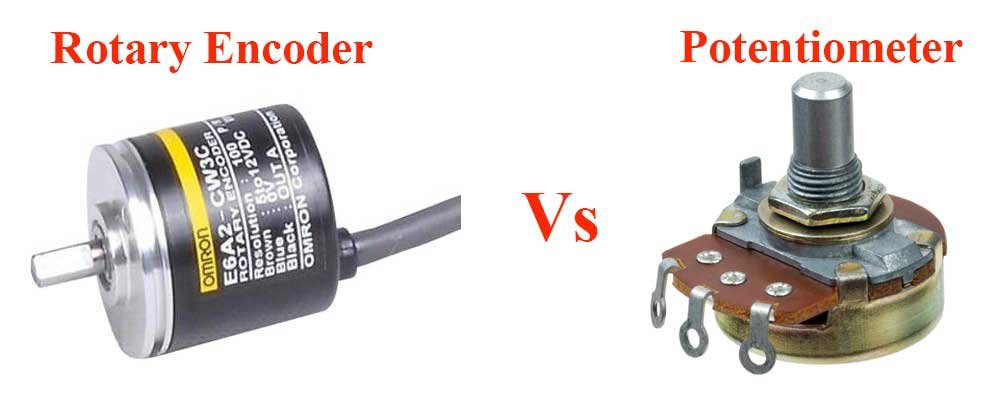
エンコーダーとポテンショメーターの比較:選び方
目次
When you need to measure position or movement in automation, robotics, or industrial control, two names usually come up: encoder vs potentiometer.
While both serve a similar purpose—providing position feedback—their working principles, strengths, and ideal use cases are very different.
Let’s dig deeper into how these two popular sensors stack up so you can make a confident choice for your next project.
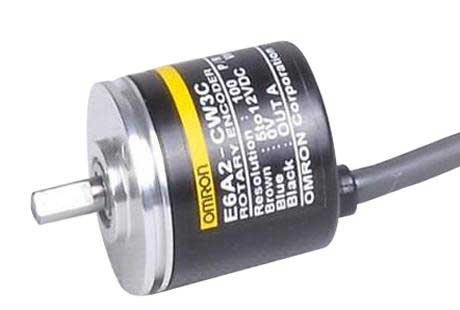
What Is an Encoder?
An encoder is a sensor that converts mechanical movement—whether rotation or linear travel—into digital signals.
It uses optical, magnetic, or capacitive technology to detect movement and outputs either pulses (incremental) or unique codes (absolute).
Encoders stand out for their high precision, reliability, and seamless integration with digital control systems.
You’ll find them in everything from industrial automation and robotics to CNC machines and advanced manufacturing setups.
Key advantages of encoders:
- High accuracy: Encoders deliver precise position and speed feedback, making them ideal for demanding applications.
- Durability: Many encoders use non-contact technology, so there’s minimal wear and long operational life.
- Digital output: Their signals are easy to process in modern control systems, supporting automation and smart manufacturing.
- Versatility: Available in rotary and linear forms, encoders suit a wide range of motion control tasks.
- Noise immunity: Digital signals are less prone to electrical noise, which is a big plus in industrial environments.
However, encoders do have a few considerations. Incremental encoders, for example, may require a homing procedure after power loss to re-establish position.
Some types can be sensitive to dust or oil contamination, especially optical models, but magnetic and capacitive designs are much more robust.
What Is a Potentiometer?
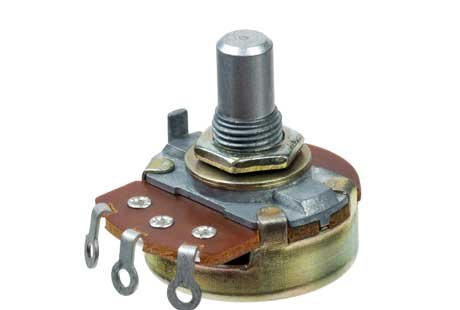
A potentiometer, or “pot,” is a much simpler device. It consists of a resistive track and a moving wiper.
As the wiper moves, it changes the resistance and produces an analog voltage that corresponds to position.
Potentiometers are widely used for basic position sensing in simple circuits, manual controls, and low-cost feedback systems.
Key advantages of potentiometers:
- Simplicity: Their design is straightforward, making them easy to use and integrate into analog circuits.
- Low cost: Potentiometers are budget-friendly, which is great for basic applications where precision isn’t critical.
- Immediate position feedback: They always provide a position signal, even after power loss, with no need for system homing.
- No programming required: You don’t need to set up or configure software—just connect and go.
That said, potentiometers come with their own set of trade-offs. Because they rely on physical contact between the wiper and resistive track, they wear out over time.
They’re also more susceptible to dust, vibration, and electrical noise. If you need long-term reliability or high accuracy, these factors can become limiting.
Encoder vs Potentiometer: Feature Comparison
| 特徴 | エンコーダー | Potentiometer |
|---|---|---|
| 出力タイプ | Digital pulses or codes | Analog voltage |
| Precision | High (especially optical types) | Moderate (limited by mechanical wear) |
| 耐久性 | Long life (non-contact options) | Wears out over time (contact-based) |
| コスト | Higher | Very low |
| Integration | Ideal for digital systems | Simple for analog circuits |
| Environmental Suitability | Robust (magnetic/capacitive types) | Sensitive to dust, vibration, wear |
| Power-on Behavior | May require homing (incremental type) | Always knows position |
| Application Focus | Precision, automation, robotics | Basic, low-cost feedback |
| メンテナンス | Minimal (non-contact types) | Needs periodic replacement |
| 信号の安定性 | Stable, immune to analog drift | Can drift due to temperature or wear |
How to Decide choose Encoder vs Potentiometer?
Choosing between an encoder and a potentiometer depends on your project’s requirements, budget, and environment.
- Choose an encoder if:
You need high accuracy, long-term reliability, or seamless digital integration. Encoders are the go-to for industrial automation, robotics, CNC machines, and any application where precision and durability matter most. They’re also ideal if your system is already built around digital controls or if you want to future-proof your design for smart manufacturing. - Choose a potentiometer if:
You want a simple, low-cost solution for basic position feedback. Potentiometers work well in manual controls, simple analog circuits, and projects where budget and simplicity are top priorities. If your application doesn’t demand extreme precision or heavy-duty cycles, a potentiometer can be the perfect fit.
Additional Considerations
- Installation and Setup: Encoders may require more careful alignment and wiring, especially for high-resolution types. Potentiometers are generally easier to mount.
- Signal Processing: Encoders output digital signals, which are less prone to interference and easier to transmit over long distances. Potentiometers output analog signals, which can degrade over long cables or in noisy environments.
- Lifespan and Maintenance: Encoders, especially non-contact types, can operate for years with minimal attention. Potentiometers, due to their mechanical nature, will eventually require replacement.
結論
Both encoders and potentiometers have their place in the world of position sensing.
Encoders excel in precision, digital compatibility, and long-term durability, making them the smart choice for advanced automation and demanding environments.
Potentiometers, on the other hand, offer simplicity and affordability for straightforward feedback needs.
Consider your project’s requirements, environment, and future scalability before making your choice.
The right sensor will keep your system running smoothly and accurately for years to come.