Imagine your factory’s electrical distribution system as a complex railway network. Trains (electric current) need signals to know when to proceed.
The AC contactor acts as the signal controller—receiving commands from operators or automation systems and determining when power flows to motors, heaters, and other industrial equipment.
This electromagnetic switch performs millions of operations over its lifetime, making it one of the hardest-working components in any industrial control panel.
What is an AC Contactor?
An AC contactor is an electrically operated switch designed for switching AC power circuits. Unlike a manual switch that requires someone to flip it, contactors respond to control signals from buttons, programmable logic controllers (PLCs), or automated systems.
This remote operation capability makes them essential for industrial machinery, HVAC systems, pumping stations, and any application where operators need to control equipment from a safe distance.
The “AC” designation means these contactors specifically handle alternating current—the standard power type in homes and industries worldwide.
DC contactors exist for battery and solar applications, but AC contactors dominate industrial settings due to their efficiency and the prevalence of AC power distribution.
Wilmall manufactures and supplies AC contactors ranging from compact units handling 9 amps to heavy-duty models like the LC1-E630 series managing currents up to 630 amps. This broad range serves everything from small workshop tools to massive industrial compressors.
Basic Structure of AC Contactor
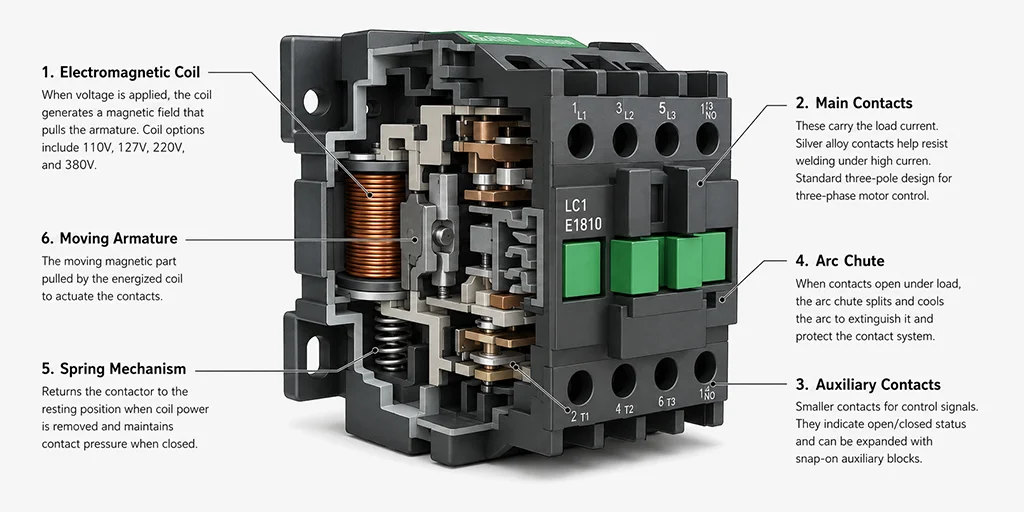
Understanding how a contactor works requires looking inside. Five main assemblies work together to create reliable switching(taking Wilmall’s LC1-E series as an example):
Electromagnetic Coil: When you apply voltage to this coil, it generates a magnetic field. Think of it as an electromagnet that pulls metal parts together. Wilmall supplies replacement coils for various voltage levels—110V, 127V, 220V, and 380V—to match different control system requirements.
Main Contacts: These contacts carry the actual load current. They use silver alloy materials to resist welding under high current. The LC1-E series from Wilmall features three main poles for standard three-phase motor applications, with optional auxiliary contacts for control circuits.
Auxiliary Contacts: Smaller contacts that handle signals rather than power. They tell other parts of your system whether the contactor is open or closed. Many Wilmall contactors offer snap-on auxiliary contact blocks that add 2 to 4 additional contacts without increasing the main unit size.
Arc Chute: When contacts separate under load, an electric arc forms. The arc chute splits and cools this arc until it extinguishes. Without proper arc management, contacts would burn and weld together within days of operation.
Spring Mechanism: Springs return everything to the resting position when you cut power to the coil. They also maintain contact pressure when closed—insufficient pressure causes heating and premature failure.
The operation sequence follows a simple pattern:
Control voltage hits the coil → Magnetic field pulls the armature → Main contacts close → Motor receives power. Cut the control voltage → Springs separate the contacts → Power stops flowing to the motor. A complete cycle takes 30 to 100 milliseconds.
Safety Standards and Regulations for AC Contactors
Electrical safety standards ensure contactors operate reliably without creating hazards. Understanding these standards helps buyers select compliant products.
IEC 60947-4-1 Compliance
The international standard governs contactors and motor starters. Key requirements include:
Minimum clearances between live parts to prevent arcing
Temperature rise limits under rated current—contacts and coils must not overheat during continuous operation
Dielectric strength testing to verify insulation integrity
Short-circuit coordination with protective devices
Endurance testing to validate mechanical and electrical life claims
Wilmall AC contactors meet IEC standards, ensuring they perform as specified in industrial environments worldwide.
WilMall AC Contactor
AC contactors are electromechanical switches designed to control electric circuits by opening and closing contacts.
They are widely used in industrial automation, motor control, HVAC systems, and commercial electrical installations.
This document provides product recommendations based on different application scenarios.
Application Scenario
Recommended Product
Current Range
Voltage
Features
Typical Equipment
Small Motor Control (Residential/Commercial)
LC1-D Series
Up to 95A
Up to 660V AC
Cost-effective, frequent starting
Air conditioners, water pumps, small fans
LC1-E Series
Up to 95A
220V/380V
High cost performance
Commercial lighting, small machine tools
CJX2-D Series
Up to 95A
24VAC-220V
IEC 60947-4 compliant
Control circuits, automation
Medium Industrial Motor Control
CJX2-F115/F150
115A-150A
380V-660V
3-phase control, high reliability
Machine tools, conveyors, compressors
CJX2-F225
225A
380V-660V
3-pole industrial grade
Industrial pumps, production lines
CIX2-D170
170A-200A
220V/380V
AC3 motor control
Machining centers, injection molding
Large Industrial Motor Control
CJX2-F400
400A
Up to 660V
High-power motor control
Large compressors, heavy machinery
CJX2-F500
500A
Up to 660V
High-capacity switching
Large industrial equipment
LC1-F500/F630
500A-630A
380V-660V
High current, stable
Large motors, power distribution
Mechanical Interlocking (Forward/Reverse)
CJX2-F400 (Mech. Interlock)
Up to 630A
AC Power
Prevents simultaneous closing
Cranes, elevators, hoists
HVAC System Applications
3TF Series
50/60Hz
AC 50/60Hz
Designed for HVAC
Central AC, ventilation, cooling towers
LC1-D Series
Up to 95A
Up to 660V
Frequent starting
AC compressors, fan coils
Power Distribution Systems
CJX2-F Series
115A-800A
380V-660V
Long-distance switching
Distribution cabinets, switchgear
LC1-F Series
115A-630A
220V-660V
Power distribution
Substations, industrial distribution
Contactor Accessories (Contacts/Coils)
CJX2/CJX4/CJ35 Contacts
115A-630A
Matching
Wear-resistant material
Maintenance, contact replacement
LC1 Coil Series
Matching
110V-380V
Multiple voltages
Coil replacement
Need AC Contactors for Your Project? Contact our team for product selection assistance, technical specifications, or bulk pricing quotes.
Conclusion
AC contactors are the backbone of industrial electrical systems, silently performing millions of switching operations throughout their service life. Understanding their construction and standards allows for safer choices for operators and machinery.
Whether you need the compact CJX2 series contactors for space-constrained switchboards or the heavy-duty LC1-F630 contactors for large industrial motors, selecting high-quality components from a reliable supplier is crucial.
Proper installation, regular maintenance, and adherence to safety standards maximize service life and minimize downtime.
For buyers seeking direct-from-manufacturer AC contactors with OEM/ODM capabilities, Wilmarll offers the LC1-E and CJX2 series, along with comprehensive technical support, ample spare parts supply, and highly competitive wholesale prices.
FAQ
Where is WilMall’s AC contactor delivery point located?
WilMall, headquartered in Yueqing, Wenzhou, Zhejiang Province, China, is a professional manufacturer and supplier of electrical equipment, primarily supplying AC contactors. The company supports global B2B buyers through factory direct sales, OEM/ODM services, and distributor supply.
What is the MOQ for AC Contactors?
The standard MOQ is 50 sets for regular AC contactor orders. For new customers, sample orders are acceptable before bulk purchasing, allowing distributors to test quality, dimensions, coil voltage, and application compatibility.
Can I get an AC Contactor sample catalog?
Yes. The AC Contactor sample catalog is being optimized, but WilMall can already support model selection and customization based on drawings, specifications, or application requirements. The website also lists CJX2, CJX4, CJ35, LC1-D, LC1-E, CJX2-F, and 3TF series AC contactor products for reference.
What materials are used for AC Contactor contacts?
The contact parts are commonly made with copper and silver alloy contact materials to improve conductivity, reduce contact resistance, and help resist welding under high-current switching conditions. WilMall offers AC contactor contacts for CJX2, CJX4, CJ35 and other series.
What is the warranty period for AC Contactors?
WilMall provides a one-year warranty for AC contactors under normal use. Damage caused by incorrect wiring, overload operation, improper installation, water ingress, unauthorized modification, or other misuse is not covered.
The Wrong Contactor Costs More Than the Right One Picking an right AC contactor is a bit like buying tires for a truck. Besides international standards, there are other points to note. Put passenger-car tires on it, and you’ll be on the side of the highway with a blowout by noon. Go wildly oversized, and […]
AC Contactor and Relay have difference? Walk into any electrical panel, and you’ll spot both contactors and relays sitting side by side. They look similar enough to fool a casual observer — both are rectangular boxes with terminals, coils, and moving contacts inside. Put a CJX2-F225 AC contactor next to a standard industrial relay, and at a […]










-1781156042-768x768.webp)