How to Choose the Right AC Contactor for Your Motor
Published: Author: Wilmall
The Wrong Contactor Costs More Than the Right One
Picking an right AC contactor is a bit like buying tires for a truck. Besides international standards, there are other points to note.
Put passenger-car tires on it, and you’ll be on the side of the highway with a blowout by noon.
Go wildly oversized, and you’re burning fuel and cash for no reason.
The sweet spot is knowing the load, the road conditions, and the numbers that connect them.
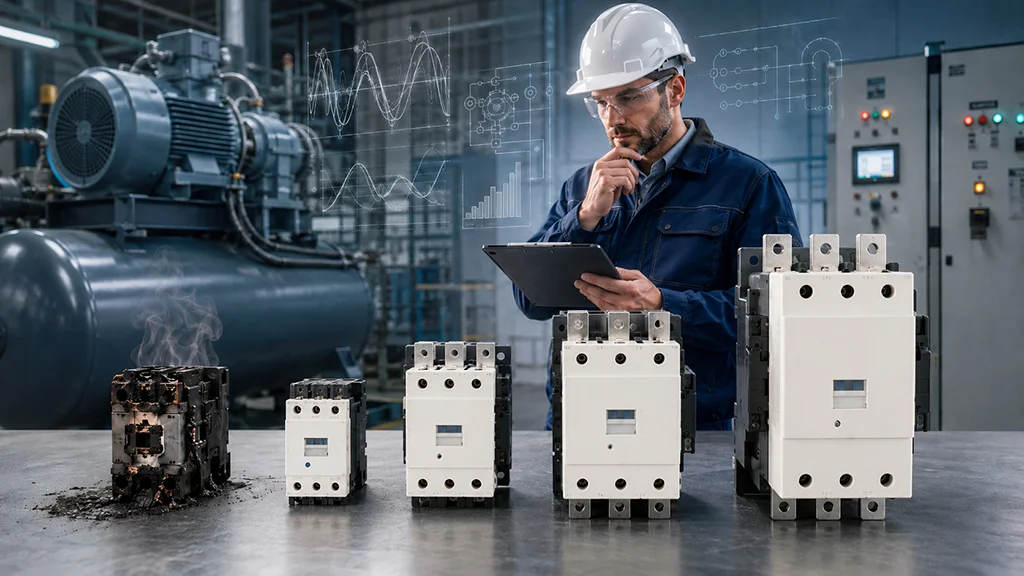
I’ve seen a 160 kW compressor eat through three undersized contactors in a single month because someone sized for the running current and forgot about the 7x inrush.
Each replacement meant production downtime, an electrician call-out, and roughly $2,400 in lost output. The correct contactor would have cost $80 more at purchase.
The math on that one isn’t hard.
This guide walks through a practical, no-fluff method for matching contactors to motors — covering the data you need, the calculation itself, the pitfalls that trip up even experienced panel builders, and how Wilmall’s product range maps directly to common motor sizes.
Key Information to Gather Before You Start
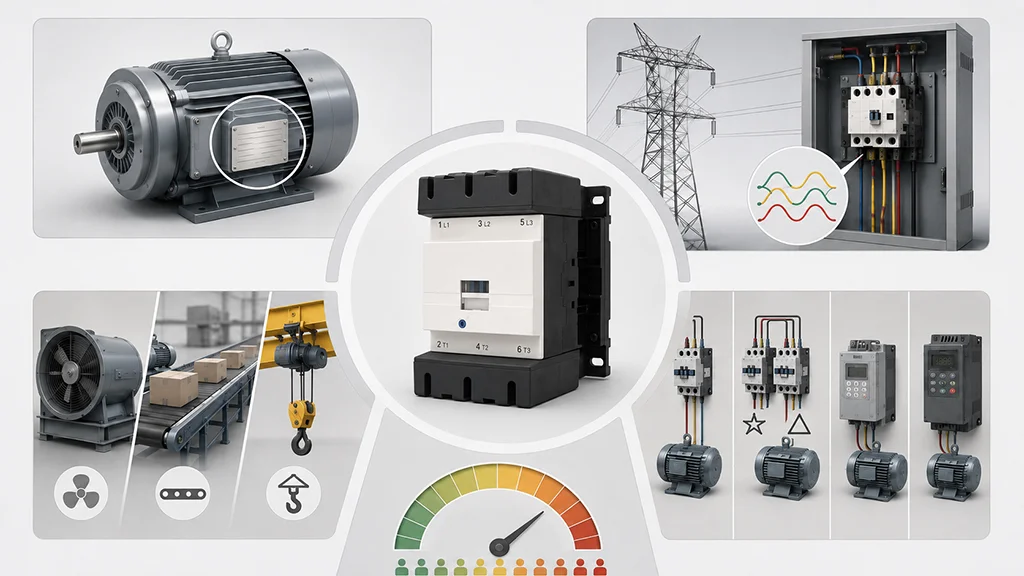
You need five numbers from the motor and the application.
Without these, you’re guessing.
1. Motor Rated Power and Current
Start with the nameplate. The full-load current (FLA or In) printed on the motor tells you more than the kilowatt rating alone.
Two 22 kW motors from different manufacturers can have different efficiency and power factor values, giving different rated currents.
The nameplate number is what the contactor will actually carry in steady state.
2. Supply Voltage and Phase Configuration
Is it 380V three-phase, 480V three-phase, or 220V single-phase?
The contactor’s rated operational voltage (Ue) must meet or exceed the system voltage. For a 380V 3-phase system, you need a contactor rated 400V or 660V — never use a 220V-rated device.
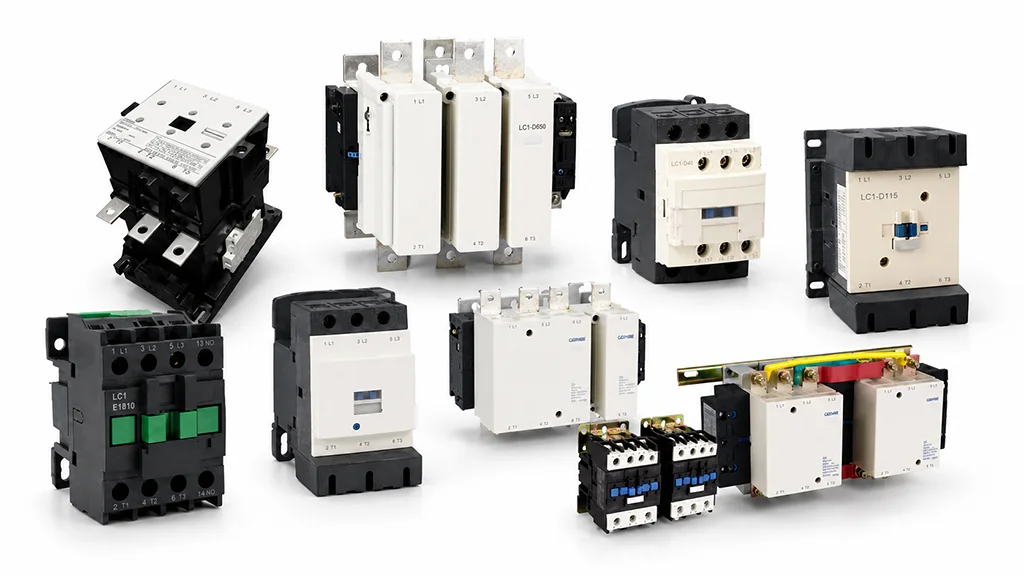
En CJX2-F series from Wilmall handles up to 660V, which covers most industrial three-phase applications.
3. Load Type
This is where things get interesting. A conveyor belt, a fan, and a crane hoist all connect to motors, but they ask very different things of the contactor:
Fan or pump (centrifugal load): Current rises gradually with speed. Relatively gentle on contacts. AC-3 rating applies.
Conveyor or compressor (constant torque): Full load from startup. Higher contact wear per operation.
Crane, elevator, or press (high inertia): Frequent starts, plugging, and reversing. This is AC-4 territory — you need a heavier contactor, often one or two frame sizes up from the AC-3 selection.
4. Starting Method
Direct-on-line (DOL) starting hits the contactor with 6-8x rated current for the first few seconds.
Star-delta starting splits that into two contactors, each handling roughly 58% of the full-load current, with the inrush on the first contactor still at 2-3x.
A soft starter or VFD changes the game entirely — the contactor only needs to handle the running current since the electronics manage the inrush.
5. Operating Frequency
How many starts per hour?
A water pump that cycles 6 times a day is a completely different animal from a production-line motor cycling 30 times per hour.
The electrical life curves in the datasheet assume a standard operating frequency (typically 600-1,200 ops/hr for AC-3).
If your duty cycle is higher, you need to derate — move up a frame size or accept that you’ll be replacing contacts sooner.
The Core Sizing Formula
Once you have the motor data, here’s the standard formula for estimating full-load current when only the power rating is available. (If you have the nameplate current, skip this and use that directly.)
Ie = P / (√3 × U × cosφ × η)
Where:
Ie = Full-load current (A)
P = Motor rated power (W)
U = Line-to-line voltage (V)
cosφ = Power factor (typically 0.80–0.90 for induction motors)
η = Efficiency (typically 0.85–0.95)
Worked example: A 37 kW, 380V, 3-phase motor with cosφ = 0.86 and η = 0.92:
So the motor draws about 71A at full load. For AC-3 duty, you’d select the next standard contactor size above that — in Wilmall’s CJX2-D (LC1-D) series, that’s the D80 (80A) or D95 (95A), depending on how much margin you want.
Quick Reference: Motor Power to Current (380V, 3-Phase)
If you want a rough rule of thumb for 380V three-phase induction motors: rated current ≈ 2 × power in kW (e.g., a 30 kW motor draws roughly 60A).
This works well enough for preliminary BOM planning, but always confirm against the actual nameplate before ordering.
The IEC 60947-4-1 standard defines utilization categories that describe exactly what the contactor is expected to switch.
Picking the wrong category is the most common reason contactors fail early.
Category
Typical Load
Making Current
Breaking Current
Aplicación típica
AC-1
Non-inductive / slightly inductive
1.5 × Ie
1.5 × Ie
Heaters, lighting, resistive loads
AC-3
Squirrel-cage motor: starting, switching off during running
6 × Ie
1 × Ie
Fans, pumps, compressors, conveyors (normal duty)
AC-4
Squirrel-cage motor: starting, plugging, inching
6 × Ie
6 × Ie
Cranes, hoists, presses, machine tools
The key difference between AC-3 and AC-4 is what happens at the moment the contacts open.
In AC-3, the motor is already running when the contactor opens — the motor’s back EMF limits the breaking current to roughly the rated value.
In AC-4, the contactor breaks the full starting current (6x Ie) — the arc is far more violent, and contact life drops dramatically.
A contactor rated for 1 million AC-3 operations might manage only 50,000 AC-4 cycles.
Practical rule: If your application involves plugging (reversing while running) or inching (repeated short bursts), select the contactor based on AC-4 ratings, not AC-3.
You’ll typically need to go up one or two frame sizes. A 37 kW motor that takes a D80 in AC-3 might need an F225 in AC-4 duty.
Wilmall Product Selection Guide by Motor Size
The table below maps common motor sizes at 380V 3-phase to the appropriate Wilmall contactor series and model.
This is a starting point — always verify against your specific motor nameplate and operating conditions.
For applications that need reversing or two-speed motor control, the CJX2-F400 mechanical interlocking contactor provides both forward and reverse contactors with a mechanical lockout that physically prevents both from closing at the same time — a critical safety feature in crane and hoist applications.
En 3TF series offers a more general-purpose alternative for applications where brand compatibility with existing panels matters.
Not Sure Which Contactor Fits Your Motor? Please contact us.
Three Common Selection Mistakes
Mistake 1: Selecting Solely on Price
An undersized contactor that costs $15 less will burn its contacts in months, not years. The replacement cost — parts, labor, and downtime — easily exceeds the initial saving by a factor of ten or more. Size the contactor first, then compare prices among correctly sized options.
Mistake 2: Ignoring Operating Frequency
A contactor rated at 1.2 million electrical operations (AC-3) might sound like it’ll last forever.
But at 30 starts per hour, 8 hours a day — that’s only about 14 months of service.
If your application runs higher than the standard assumptions baked into the catalog ratings, derate or move up a frame size.
The larger contact has more contact material to burn through before failure.
Mistake 3: Skipping Environmental Derating
Contactors carry a thermal current rating (Ith) at 40°C ambient. Inside a sealed IP65 enclosure under a tropical sun, the internal temperature can easily climb 15-20°C above that.
Every 10°C above 40°C costs roughly 5-10% of the contactor’s current-carrying capacity.
If your panel sits in a hot environment, factor this in — or pick a series like the 3TF rated for higher ambient operation.
Altitude matters too. Above 1,000 meters, thinner air reduces both cooling and the dielectric strength of the arc gap.
Most manufacturers specify a derating curve — typically 1% per 100m above 1,000m.
Practical Selection Checklist
Before you place an order, run through these seven checks.
If you can answer all of them with actual numbers, you’ll get the right contactor on the first try.
Motor rated current (nameplate value)?
Not the catalog kW-to-current estimate — the actual stamped number.
System voltage and phase count?
220V single-phase and 380V three-phase need different contactors.
Utilization category: AC-1, AC-3, or AC-4?
The difference between a D80 and an F225 for the same motor.
Starts per hour and daily operating hours?
Higher frequency means shorter contact life — size accordingly.
Ambient temperature and altitude?
Derate if above 40°C or 1,000 meters.
Coil voltage available in the panel?
Wilmall offers 24V, 110V, 220V, and 380V coils — match your control circuit.
Auxiliary contacts needed?
Count your seal-in, interlock, and PLC feedback signals before ordering.
One last point worth remembering: coils have an inrush too.
A large contactor’s coil can pull 200-500 VA at the moment of energization even though the sealed (holding) power is only 5-50 VA.
If you’re driving the coil from a PLC output or a small control transformer, make sure it can handle that surge without tripping or dropping voltage enough to cause contact chatter.
When in doubt, use an interposing relay — let the relay handle the coil load.
What is the difference between AC-3 and AC-4 contactor duty?
AC-3 is used for standard motor starting and stopping at full speed, while AC-4 is used for heavy-duty operations like inching, plugging, and frequent reversing, which require higher durability.
Do I need to consider supply voltage when selecting a contactor?
Yes. The contactor’s rated operational voltage (Ue) must be equal to or higher than the system voltage (e.g., 380V systems require 400V or 660V rated contactors).
Why is motor full-load current more important than kW rating?
Because motors with the same kW rating can have different efficiency and power factor values, resulting in different actual current draw. The FLA on the nameplate is the most accurate selection reference.
How does motor starting method affect contactor selection?
Direct-on-line (DOL) starting produces the highest inrush current, while star-delta reduces it. VFD or soft starters reduce stress on the contactor and may allow smaller sizing.
What is the impact of frequent operation on contactor life?
High operating frequency increases mechanical and electrical wear. Applications with frequent starts per hour require derating or selecting a higher frame size contactor.
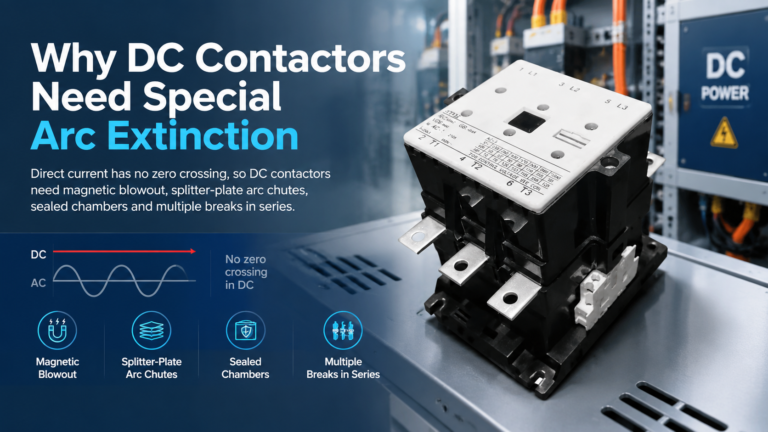
DC contactors need special arc extinction because DC current has no natural zero crossing. See how magnetic blowout, arc chutes and series breaks kill a DC arc — and how to specify one correctly.
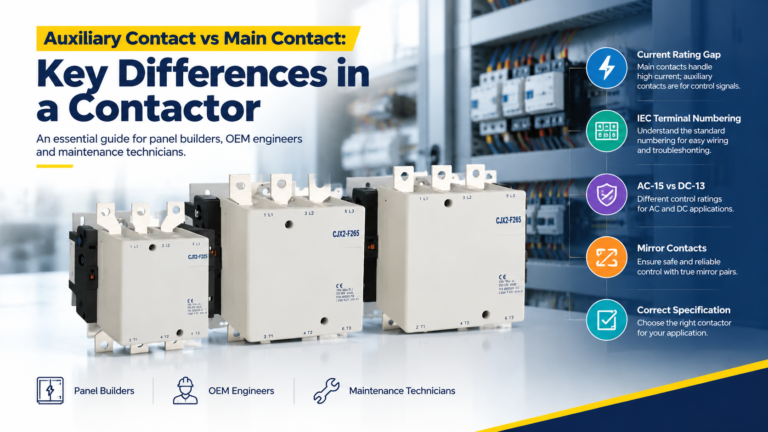
Main contacts carry the motor current; auxiliary contacts carry control signals. Learn the real rating gap, IEC terminal codes, and how to spec both correctly.
A sourcing guide to modular contactor manufacturers: match the four supplier archetypes, qualify any factory with a nine-point framework, and send an RFQ that gets comparable quotations.