






Why Is My MCB Tripping? Causes & Fixes
Your MCB trips for four main reasons: overload, short circuit, earth leakage, or a faulty breaker. This guide explains each cause, how to find it, and how to fix it safely.
Read More
When buyers search for a pendant control station, they usually do not want theory dressed up like wisdom. They want to know three things fast: how it connects, how to choose it, and which version actually fits the machine in front of them. I get it. Nobody wants a control station that looks perfect in a catalog and then acts confused on a hoist line.
In the market, comparable COB Series style units are commonly positioned for hoists, cranes, and outdoor or dusty use, and sellers frequently highlight ABS housings plus dustproof or rainproof sleeves. Comparable 6-button XAC-A style pendants are also sold for overhead crane control, with emergency stop options and IP65 protection in some versions. So, if your reader is looking for a crane pendant control station, a hoist pendant control station, or a 6 button pendant control station with emergency stop, this is not a niche topic at all. It is a very practical buying decision with very real downtime costs.

I always start with the boring-looking stuff, because boring-looking stuff usually prevents expensive mistakes. A pendant control station is only “simple” until someone picks the wrong contact arrangement, the wrong cable size, or the wrong environmental rating. Then the maintenance team starts inventing creative vocabulary.
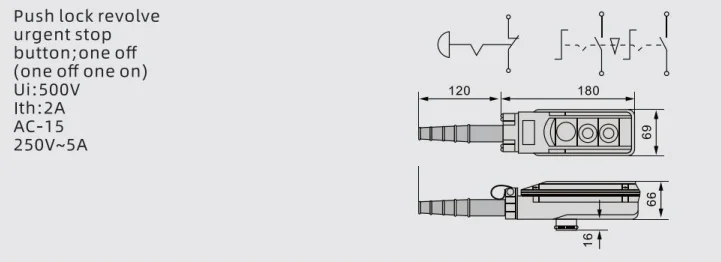
For this article, I am focusing on the COBC-61C style product you provided. The supplied drawing shows a push-lock, twist-release emergency stop, with Ui 500V, Ith 2A, and AC-15 250V/5A, and it also shows a body length marked 180 mm, a cable sleeve section marked 120 mm, and a width around 69 mm. Those numbers matter because they immediately tell me this is a control-circuit product, not a “let’s switch the motor power directly and hope for the best” kind of device. The same drawing also indicates a one-off/one-on contact arrangement around the emergency stop symbol, which is exactly the kind of detail a purchasing engineer should confirm before placing volume orders.
The COBC-61C drawing gives us a strong starting point. The emergency stop is shown as a push-lock, rotate-release type, which is the standard behavior most industrial buyers expect in a machine-side control product. The electrical marking of Ui 500V, Ith 2A, and AC-15 250V/5A tells me this unit belongs in the control circuit world, where pushbuttons command contactors, relays, or PLC inputs, rather than carrying the full motor load directly. That distinction sounds small, but it changes how I talk to a buyer, how I quote the product, and how I prevent returns.
Now let me turn those specs into buyer language. If I am talking to an OEM, a panel builder, or an MRO buyer, I would describe this as a replacement pendant control station for overhead crane and hoist control where the operator needs hand-held directional command plus a clear emergency stop action. I would not describe it as a main disconnect. That would be like using a spoon to repair a gearbox: technically an object was selected, but not the right one.
Another practical point is form factor. A compact body with a visible emergency stop and multiple control positions is useful when the operator must work with one hand while watching hook travel, trolley motion, or machine positioning. Comparable 6-button pendant products in the market are explicitly used on overhead crane control circuits, which lines up well with the COBC-61C buying context. So if your audience asks, “Is this a serious industrial part or just a generic switch box?” the answer is simple: the architecture, rating style, and market comparables place it firmly in serious control duty.
Let me be clear: buyers do not need a wall of wiring poetry. They need clean logic. When I help a customer choose a pendant control station, I break the connection question into three layers: control power, stop logic, and motion commands.
First, I treat the emergency stop as part of the safety-related stop chain in the control circuit. The supplied drawing shows a latching emergency stop with a defined contact arrangement, and that means the buyer must confirm whether the machine requires normally closed stop logic, additional monitoring, or a safety relay architecture upstream. In everyday factory terms, the emergency stop should interrupt the control command path so the contactor or control relay drops out immediately when the button is pressed. That is the clean, expected behavior most machine builders want.
Second, I wire motion buttons as command inputs, not as direct power switching for the motor. Why? Because the product marking is AC-15 250V/5A, which is a classic control-duty style rating, and that tells me the switch is intended to operate electromagnetic loads in the control circuit. If the application is a hoist pendant control station, that usually means the buttons energize forward/reverse or up/down contactors, often with electrical interlocking handled elsewhere in the control design.
Third, I always ask the buyer whether the motion is single-speed or two-speed. A lot of wrong purchases happen because the customer says “6 buttons” when what they really mean is “up/down/left/right/start/stop,” while the machine actually needs “up slow/up fast/down slow/down fast” behavior. Similar 6-button market units exist in overhead crane applications, but the button count alone does not tell the whole story.
As shown in the diagram below:
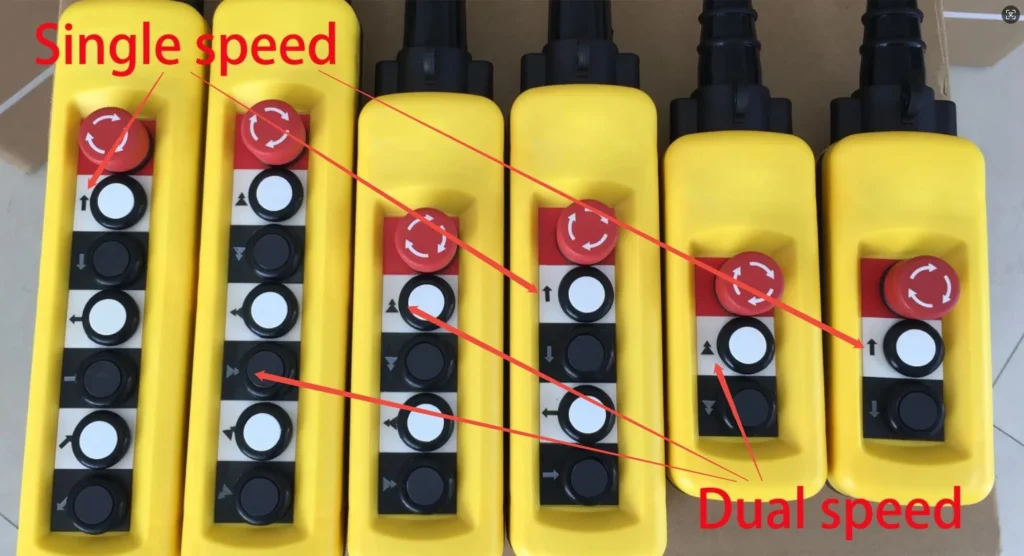
In practice, I tell customers to verify five connection facts before they buy in quantity. One: control voltage. Two: button function map. Three: emergency stop contact requirement. Four: cable outer diameter and strain relief. Five: whether the machine logic uses direct relay control or PLC input cards. If any one of those is fuzzy, I slow the order down. A one-day delay in quoting is cheaper than a month of explaining why the pendant arrived “almost right.”
This is also where a good supplier earns the order. A capable pendant control station manufacturer should be able to confirm terminal logic, contact combinations, enclosure material, and any custom marking requirement before mass production. Buyers asking for a waterproof pendant control station or an OEM pendant control station are usually not being picky. They are trying to avoid field modification, and honestly, I support that. Field modification is where neat drawings go to cry.
Not every buyer should buy the same pendant control station, even when the outside shape looks similar. Selection depends on application intensity, environment, replacement compatibility, and whether the order is one piece or one hundred pieces. I have seen customers lose time by focusing only on price while ignoring the contact layout and operating environment. The switch was cheap; the downtime was not.
Comparable COB-61 products are promoted for outdoor, snowy, and dusty environments and often use ABS housings with rubber sleeve features. Comparable XAC-A671 6-button units are used for overhead crane control and are sold with emergency stop arrangements and IP65 variants. So when I am choosing “which model,” I am really choosing the right balance of environment, function count, and durability expectation.
If I were advising a buyer for a basic lifting application, I would choose the COBC-61C style when the job requires reliable hand-held control, a visible emergency stop, and a familiar industrial shape that technicians can recognize instantly. The supplied dimensions also suggest a size that is practical for handheld use rather than an oversized housing that becomes annoying after one shift. If the buyer is replacing an aging crane pendant control station, I would tell them to compare not only the number of buttons but also the release method of the emergency stop, the terminal arrangement, and the cable sleeve geometry.
For a buyer in harsher environments, I would push harder on sealing and enclosure material. Similar COB-61 listings highlight ABS construction and dustproof or rainproof design language, which tells me the market already expects these products to work beyond clean indoor benches. Still, I would not assume every version is equally sealed just because the family name looks familiar. In B2B, assumptions are expensive little creatures.
For an OEM or distributor, the smarter conversation is not “What is your lowest price?” but “What is the right repeatable configuration?” That means confirming label language, contact blocks, cable gland requirements, carton markings, and inspection criteria. If the product will be sold as a replacement pendant control station for overhead crane service, consistent configuration matters more than shaving a few cents off the unit cost. Buyers remember stable supply. They also remember when cartons arrive with the wrong legend plate, and not in a loving way.
A good pendant control station should make the operator feel in control, the engineer feel relaxed, and the buyer feel clever. For the COBC-61C style, the practical value is clear: the supplied drawing confirms a latching emergency stop and control-duty electrical rating, while comparable market references place this format in real hoist and crane control use. If I were writing for B2B buyers, I would position it exactly that way: a practical industrial control component that becomes much easier to buy once the customer locks down the contact logic, environment, and application fit.
The supplied marking of AC-15 250V/5A, Ui 500V, and Ith 2A points to control-circuit use rather than direct main motor power switching.
Yes, the drawing shows a push-lock, twist-release emergency stop arrangement.
Comparable COB-61 and XACA-style products are marketed for hoist and overhead crane control duties.
Similar COB-61 products are sold with dustproof and rainproof sleeve claims, but the exact sealing level should be confirmed for the purchased version.
Button layout, contact logic, control voltage, enclosure expectation, dimensions, and replacement compatibility should be locked before ordering.
Depends on duty cycle and environment. If the application is standard industrial control with familiar hoist or crane commands, a COBC-61C-style unit can be a practical choice. If the site has harsher exposure or stricter enclosure expectations, I would compare against higher-protection market options because similar 6-button overhead crane pendants are sold with IP65 positioning in some ranges
No, not if we are respecting the rating and using the product correctly. The marking style shown on the drawing tells me this is for control duty, so I would use it to command the circuit, not to carry the main power path.