






How to Test an AC Contactor: Step-by-Step Guide
Step-by-step guide to testing an AC contactor with a multimeter: check the coil, main and auxiliary contacts, and pull-in, and interpret every reading.
Read More
A metal enclosure is one of those parts of an electrical system that is easy to overlook until the wrong one fails. Choose the right type and your switchgear, controls, or solar connections stay protected for years; choose the wrong one and you are looking at rust, dust ingress, overheating, or a failed inspection. The good news is that picking the right metal enclosure comes down to a small set of practical decisions: where it will sit, what it must protect against, how the components mount inside, and how much access you need. This guide walks through the common metal enclosure types, the materials they are made from, the IP ratings that describe their protection, and the questions that point you to the right choice for your application.
A metal enclosure is a protective housing for electrical and electronic components such as circuit breakers, contactors, terminals, controllers, and meters. It protects people from live parts, protects the equipment from dust, water, and mechanical damage, and provides a safe place to mount and wire the components.
Type matters because enclosures are not interchangeable. A small wall-mounted box that works for a junction point will be far too small for a control panel with multiple contactors and a DIN rail, and a single-door cabinet that suits a clean indoor environment may corrode or let water in on a coastal rooftop. Understanding the main types and their intended use is the first step before you request a quote.
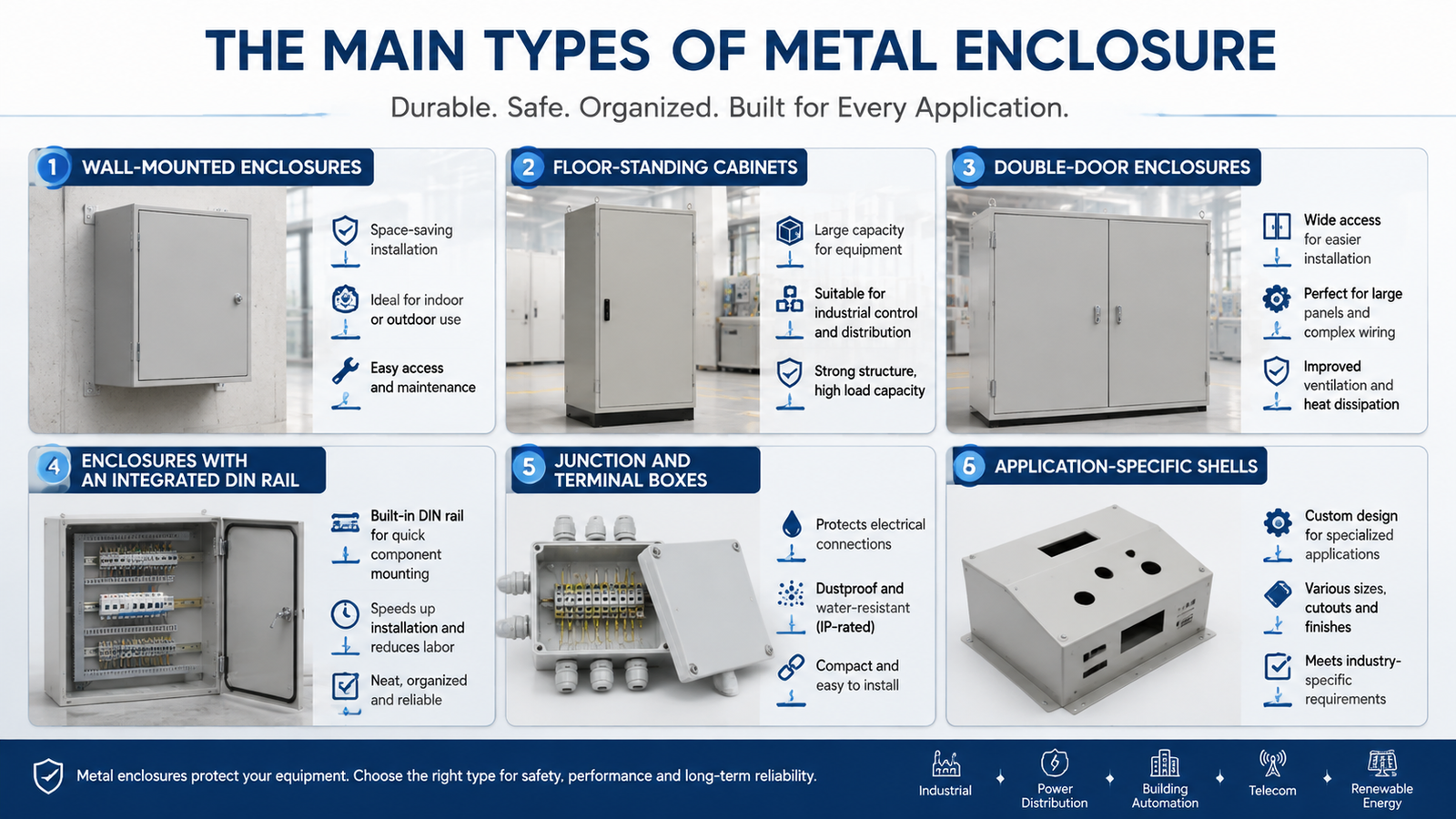
Metal enclosures are usually classified by how they are mounted and how they open. Here are the types you will meet most often in low-voltage electrical work.
The material of the metal enclosure decides its strength, corrosion resistance, weight, and cost. Most manufacturers offer a choice of sheet materials, and the best option depends on your environment.
| Material | Best for | Typical finish | Considerations |
|---|---|---|---|
| Cold-rolled steel | Indoor panels, general industrial use | Powder coating or painting | Strong, affordable, and easy to customize, but needs a protective coating to resist corrosion. |
| Galvanized steel | Indoor and mildly humid areas | Zinc coating | Better corrosion resistance than plain steel at a low cost; often used for structural parts and outdoor-rated boxes. |
| Stainless steel | Outdoor, coastal, food, and chemical environments | Brushed or polished surface | Best corrosion resistance and a clean appearance, but heavier and more expensive. |
| Aluminum alloy | Lightweight panels and portable equipment | Anodizing or powder coating | Lightweight and corrosion-resistant, but generally costlier per unit than steel and less rigid for very large panels. |
For most industrial and commercial installations, powder-coated cold-rolled or galvanized steel gives the best balance of strength, price, and protection. If the enclosure will live outdoors, near the sea, or in a wash-down area, stainless steel is usually worth the extra cost.
The IP (Ingress Protection) rating is the most important number on an enclosure specification because it tells you how well the box keeps out dust and water. The rating has two digits: the first describes protection against solid particles and dust, the second against water.
| IP rating | Solid protection | Water protection |
|---|---|---|
| IP54 | Dust protected | Splash water from all directions |
| IP65 | Dust tight | Low-pressure water jets |
| IP66 | Dust tight | Powerful water jets |
For outdoor installations, a rating of IP65 or above is the safe baseline because the enclosure must keep dust out completely and withstand rain and hose-down cleaning. If the equipment will face heavy wash-down, coastal spray, or weather exposure in an industrial yard, choose IP66 or higher. Wilmall’s IP65/IP66 metal enclosures with an integrated rail system are a direct example of this type of weather-rated enclosure built for distribution and control applications.
Work through these questions in order and the right enclosure type becomes obvious.
Indoor installation in a dry, clean environment needs less protection than outdoor, coastal, or wash-down areas. Decide the location first because it sets the minimum IP rating and material.
Count the components and check whether they clip onto a standard 35 mm DIN rail. If most of your parts are DIN rail mounted, an enclosure with an integrated rail is the fastest and tidiest option. If you have large components or bulky wiring, add space for heat dissipation and cable bending radius.
Size the box for the components plus at least 20–30% spare space for wiring, airflow, and future changes. Undersized enclosures run hot and become difficult to maintain. Manufacturers such as Wilmall supply enclosures in many standard sizes and can produce custom dimensions.
Frequent access means you want a door with good hinges and a reliable latch or lock. Large panels are easier to service as double-door metal enclosures that open the whole front, while junction points only need a removable cover.
Solar and photovoltaic systems, for example, need enclosure shells that match the combiner box layout and cable glands. In this case an application-specific design, such as a customized PV combiner box metal shell, is usually the right call because it is built around the exact components.
Putting the choices together, here is how typical applications map to an enclosure type.
| Application | Typical enclosure | Why |
|---|---|---|
| Small junction and cable terminations | Junction or terminal box | Compact, protects connections without taking up space. |
| Distribution boards in buildings | Wall-mounted enclosure with DIN rail | Breakers and terminals clip on quickly; tidy and easy to expand. |
| Machine control panels | Wall-mounted or floor-standing cabinet | Enough room for contactors, PLCs, and wiring, with door access. |
| Main switchboards | Floor-standing multi-door cabinet | Large capacity with front access across the whole panel. |
| Solar combiner boxes outdoors | Application-specific metal shell | Matched to the combiner layout, cable entries, and outdoor rating. |
To see the principles applied to real products, read our guide to what a distribution box is and how to choose the right distribution box for your needs. For solar installations, our PV combiner box selection guide covers the enclosure considerations specific to photovoltaic systems.
Most metal enclosures are made to order, which means you can specify dimensions, door layout, cutouts, cable glands, mounting plates, and finish. This is valuable when the enclosure must fit a particular space or component layout. When sourcing, ask about the material grade, surface treatment, IP rating test certificate, and minimum order quantity. Buying directly from a manufacturer that offers OEM/ODM services usually gives you more flexibility on dimensions and details than buying a fixed catalog product.
Powder-coated cold-rolled steel is the most common because it offers a good balance of strength, cost, and protection for indoor and general industrial use.
Both are dust tight. IP65 protects against low-pressure water jets, while IP66 protects against powerful water jets. Choose IP66 when the enclosure will face heavy wash-down or severe weather.
Yes. Factories that offer OEM/ODM services can produce enclosures with custom dimensions, door layouts, cutouts, and finishes to match your components and space.
If your breakers, contactors, and terminals are DIN rail mounted, an integrated-rail enclosure saves assembly time and keeps the panel tidy. It is a strong choice for distribution boxes and control panels.
Only when corrosion resistance matters more than cost and weight. For dry indoor environments, powder-coated steel is usually more economical while still offering solid protection.
The right metal enclosure starts with the environment, then follows from what goes inside and how the panel will be used. Decide the location and minimum IP rating, choose a material that matches the corrosion risk, size the box with room to spare, and pick a door and mounting style that make maintenance easy. For standard distribution and control panels, an IP65 or IP66 metal enclosure with an integrated DIN rail is a practical, cost-effective default; for solar and specialized products, order a shell designed around your components.
If you are sourcing enclosures for a project, contact the Wilmall team with your component list, dimensions, and installation environment, and we will help you match the right metal enclosure type to your application.